DANCE IN STONE
EN
“Stones carry ideas, but they cannot withstand hammers” - Leja Jurišić
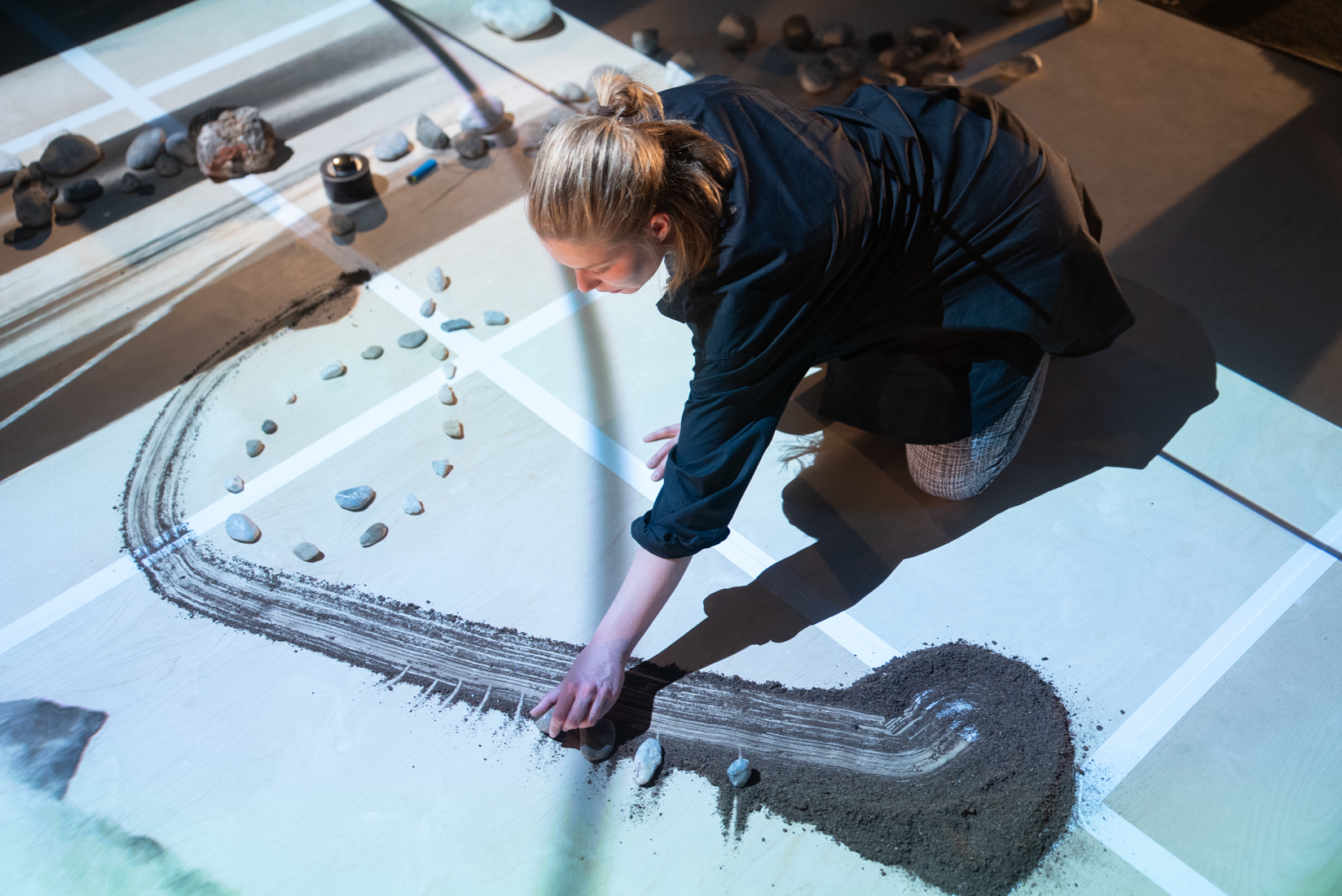
The puppet show The Philosopher Stone primarily opens up the question of how modern human society can so often shape an individual who hates themselves, who is their own greatest rival, their own most despised other. The stones, which in the show function as puppets and also as scenography, symbolise the radical other, that which seems uncontrollable or unacceptable – both within ourselves and in society. The performance is aimed at primary school students in their third triad.“We have entered an age where it seems all have fallen silent on what is essential, even when they speak, and suddenly the very stones must cry out.” - Miklavž Komelj
The performance is a hybrid of genres; it contains elements of postdramatic theatre, dance, object theatre, and installation, but the fundamental state of mind it tries to evoke is poetry. It establishes various registers, from the mythically sublime to the humorous. The words that meet the stones in this performance range from the re-creation of humans after the great flood, which Deucalion and Pyrrha achieve by throwing stones in Ovid's Metamorphoses, through Kafka's interpretation of the myth of Prometheus, to the poetry of Anton Aškerc, Jure Detela, and Miklavž Komelj. At the same time, it establishes a true palimpsest of intertextual connections; the final effect is linked to the description of the mysterious stone in Pier Paolo Pasolini's novel Petrolio: "The infinite variety of its gentle colors corresponds to the infinite variety of substances, but none of them were truly recognized, because each mineral has contradictory properties, both in relation to itself and in relation to the other minerals with which it is mixed or of which it is composed: in that stone it was impossible to separate what seemed precious from what seemed worthless or even toxic; to this day it has been impossible to define its inaccessibility to analysis and its complete contradictoriness […]"
SI
Naslov predstave je poklon kratki pesmi Jureta Detele: »Bodi v kamnu, magični ples, / prišle so sanje, odzgoraj, / selijo se misli!« Kamen običajno dojemamo kot nekaj neživega in nepremičnega, ta predstava pa poskuša odkriti ples, ki je v kamnu, in raziskuje, kako se ta ples lahko povezuje s sanjami in mislimi. In s seljenjem in spreminjanjem misli, kajti tak pristop h kamnu je mogoč samo skozi proces »razbijanja« lastnih omejitev v dojemanju sebe in sveta. V najbolj ikonični predstavi Lutkovnega gledališča Ljubljana, Zvezdici Zaspanki, ima razbojnik kamen namesto srca in potem se kamen spremeni v srce.
Miklavž Komelj pa med drugim v procesu napiše tole pesem Čudež: ČUDEŽ /Za Lejo Jurišić/ S takim prepričanjem držati kamen, / da je, ko ga izpustiš, / enak čudež, če ti pade na tla / ali če ti poleti v nebo.
Predstava je zvrstno hibridna; vsebuje elemente postdramskega gledališča, plesa, gledališča objektov in instalacije, temeljno stanje duha, ki ga poskuša priklicati, pa je poezija. Vzpostavlja različne registre, od mitsko vzvišenih do humornih. Besede, ki se v tej predstavi srečujejo s kamni, gredo od ponovnega stvarjenja ljudi po vesoljnem potopu, ki ga z metanjem kamnov dosežeta Devkalion in Pira v Ovidijevih Metamorfozah, prek Kafkove interpretacije mita o Prometeju do poezije Antona Aškerca, Jureta Detele in Miklavža Komelja, obenem pa vzpostavlja pravi palimpsest medbesedilnih povezav; končni učinek se povezuje z opisom skrivnostnega kamna v romanu Nafta Piera Paola Pasolinija: »Neskončna raznolikost njegovih blagih barv ustreza neskončni raznolikosti snovi, a nobene od njih v resnici niso prepoznali, kajti vsak mineral ima protislovne lastnosti, tako v odnosu do samega sebe kakor tudi v odnosu do drugih mineralov, s katerimi je pomešan oziroma iz katerih je sestavljen: v tistem kamnu ni bilo mogoče ločiti tistega, kar se je zdelo dragoceno, od tistega, kar se je zdelo brez vsake vrednosti ali celo strupeno; do danes ni bilo mogoče opredeliti njegove nedostopnosti za analize in popolne protislovnosti […]«
CREDITS
EN
Author, director and choreographer: Leja Jurišić
Author of texts: Miklavž Komelj
Authors of used texts: Franz Kafka, Jure Detela, Anton Aškerc, Mia Skrbinac, Alenka Tetičkovič
Dramaturgs: Petra Veber, Leja Jurišič
Set designer, costume designer and lighting designer: Petra Veber
Author of music: Eduardo Raon
Video author: Atej Tutta
Animation consultant: Martina Maurič Lazar
Language consultant: Irena Androjna Mencinger
Puppet technologist: Zoran Srdić
Co-creators of the performance: Rok Kunaver, Gašper Malnar, Martina Maurič Lazar, Alenka Tetičkovič, Mia Skrbinac
Cast: Rok Kunaver, Gašper Malnar, Martina Maurič Lazar, Alenka Tetičkovič, Mia Skrbinac
Head of the performance and sound designers: Damir Radončić
Producer: Alja Cerar Mihajlović/Katra Krsmanović
Lighting direction: Maša Avsec
Stage technician: Darko Nedeljković
Wardrobe: Nataša Konić
Make-up artist: Anja Pika Lopatič
Workshop leader: Zoran Srdić
Production of puppets, sets, props and costumes: David Klemenčič, Olga Milić, Sandra Birjukov, Lorena Bukovec, Emma Serra Rius, Zoe Špehar, Uroš Mehle, Artiko, Pleksi izdelki Vrhovec Acknowledgements: Jiři Bezlaj, Ema Kugler, Andrej Detela, Marko Pogačnik
Co-production: Ljubljana Puppet Theatre and Pekinpah
PREMIERE
23 October 2025
Ljubljana Puppet Theatre
December at 6 pm - Opening: intervention 7' Leja Jurišić, installation + talk with translator
2 December at 5pm: intervention 7' Leja Jurišić, installation
3 December at 5pm: intervention 7' Leja Jurišić, installation